

Parallel computation
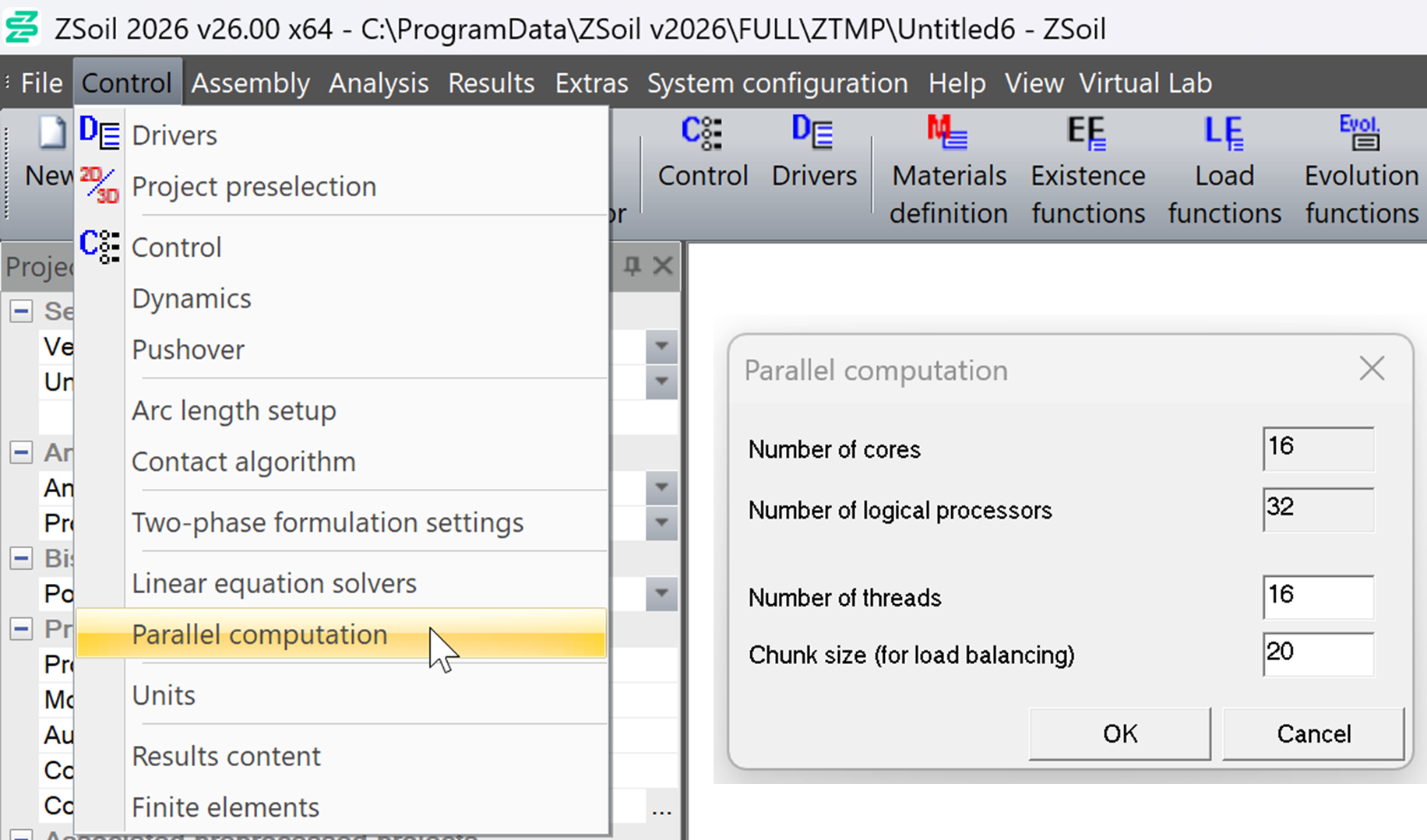
Parallel computation with the shared memory model has been implemented in ZSoil 2026. Depending on the model size, the nonlinear solver used, and the number of iterations, a speedup of 1.4 to more than 5 times can be observed. The number of threads can be set under Control/Parallel computation and some examples of the calculation speedup are given below.
Foundation raft benchmark – BFGS nonlinear solver, 60 – total number of iterations

Foundation raft benchmark – Full Newton-Raphson nonlinear solver, 60 – total number of iterations

Consolidation benchmark – Initial stiffness accelerated nonlinear solver, 240 – total number of iterations

Stiffness ANISOTROPY for HS-Brick and HS-small models
In the ZSoil version 2026, stiffness cross-anisotropy is introduced using the so-called xA2 concept proposed by Niemunis and Staszewska (Niemunis, A. and Staszewska, K. (2022). Pure cross-anisotropy for geotechnical elastic potentials. Acta Geotechnica, 17:1699–1717). In this approach, an arbitrary isotropic stiffness tensor is modified by a scaling tensor to account for cross-anisotropy. Details of the method can be found in the aforementioned paper, while the implementation within the HS-small and HS-Brick models is described by Cudny et al. (Cudny, M., Lisewska, K., and Truty, A. (2025). Incorporation of cross-anisotropic small strain stiffness into the hardening soil model. submitted to Acta Geotechnica).

User interface for setting cross anisotropic parameters

Extended calculator for setting cross anisotropic parameters

Dialog box enabling simplified mapping stiffness parameters from isotropy to anisotropy

Dialog box enabling simplified mapping stiffness parameters from anisotropy to isotropy
Twin tunnels excavation in London Clay using anisotropic HS-Brick model

Soil stratigraphy and diagonally oriented tunnels at St James’s Park, London, UK (after Cudny, M., Lisewska, K., Winkler, M., and Marcher, T. (2024). Modelling tunnelling-induced deformation in stiff soils with a hyperelastic-plastic anisotropic model. Acta Geotechnica, 19:4873–4894)

Surface settlement profiles after excavation of the westbound tunnel

Surface settlement profiles after excavation of the eastbound tunnel
Active Learning Reliability
Active learning reliability (ALR) is a strategy for estimating the probability of failure in an automated way. A metamodel is created and reliability analysis is performed. Iteratively the experimental design of the metamodel is enriched with automatically generated samples. The QoI of the samples are evaluated in ZSoil.

New user interface for Materials

New user interface for Load functions

New user interface for Boreholes

Load table with bulk edit
